Archive
Python: My Orders Tracker P-3
Learning : Pythn, sqlite, Database, SQL
Subject: Create a system to track the orders
In this part we will write the code to Delete an Order that we have from our system, also we will add some validations on the user input, like if the user enter something not from the menu, or to do so, first we will re-call the show_orders() function that we have and passing the ‘yes’ parameter which means we are calling the function from inside another function [we will not print the function header, and will not clear the screen]. Then we will ask the user to select/Enter the ID of the order to be Deleted, after that we will print tha order details again on the screen and ask the user to confirm Deleting command by entering ‘Y’ … thats it.. let’s write the code..
# Delete Order

def del_order():
    os.system('clear')
    print("\n==========[ Delete Orders ]==========\n")

    show_order('yes')

    del_order = input('   Select the Order ID to be Deleted. [E to Exit] > ')

    if not del_order.isnumeric() :
        input('\n   You need to enter an Orders ID [Numeric]. .. Press any Key .. ')
        return

    elif del_order in ['e','E'] :
        return

    try:
        c.execute ("select * from orders where o_id ={}".format(del_order))
        order_list = c.fetchone()

        if order_list == [] :
            input('\n   ID {} not exsist.'.format(del_order))
            return

        os.system('clear')
        print("\n==========[ Delete Orders ]==========\n")
        print('\n   Details of the Order you select:\n ')

        print("   ID: ",order_list[0])
        print("   Date: ",order_list[1])
        print("   Order Number: ",order_list[2])
        print("   Price: ",order_list[4])
        print("   Quantity: ",order_list[5])
        print("   Shipment Price: ",order_list[6])
        print("   Total Cost: {:.2f}".format((order_list[4]*order_list[5]) + order_list[6]))
        print("\n   Description:",order_list[3])
        print("   Image:",order_list[8])
        print("   Link:",order_list[7])

        user_confirm = input("\n\n   You Select to DELETE the above Order, Enter Y to confirm, E to Exit. > ")
        if user_confirm in ['y','Y'] :
            #To Delete the order..
            c.execute ("delete from orders where o_id ={}".format(int(del_order)))
            db_conn.commit()

            input('\n   One record has been DELETED ... \n      ... Press any key to Continue ...')

        elif user_confirm in ['n','N']:
            input("\n    You select not to DELETE any thing.   Press any key to Continue .. ")

        elif user_confirm in ['e','E']:
            input("\n    You select stop the process and EXIT.    ... Press any key to Continue .. ")
            return

        else:
            input('\n      Wrong input ... Press any key to continue ..')

    except:
        pass
The user select #3 from the menu to Delete an Order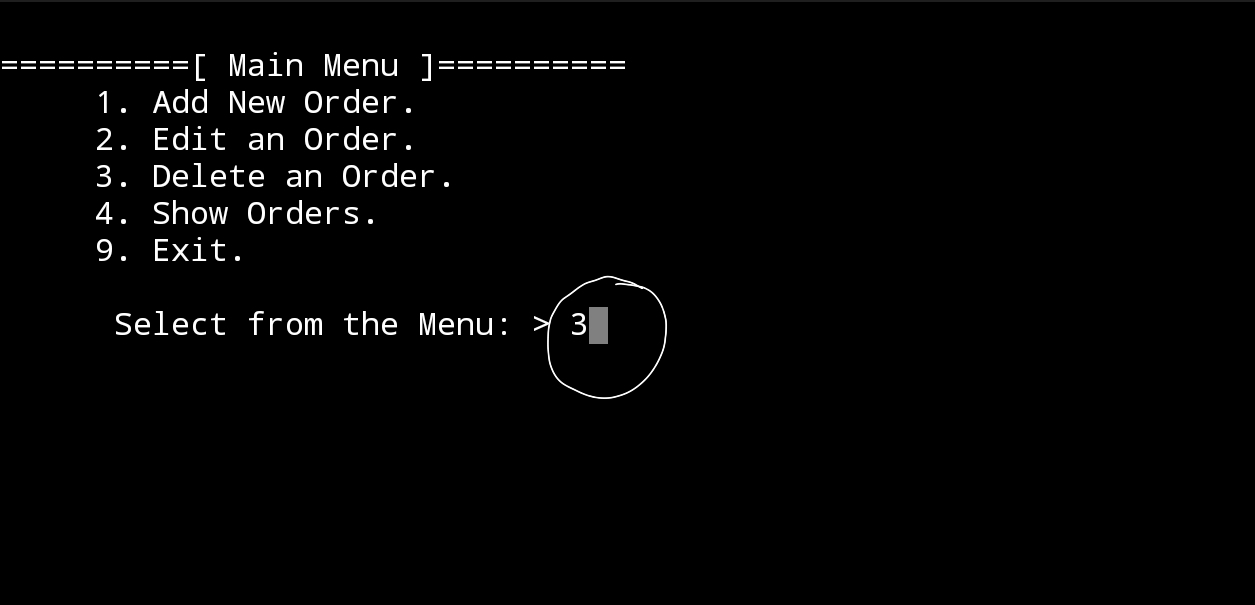 |
The screen display the list of orders we have in the system, and the user select Order ID Number 3 to delete it. |
The screen display the details of the order ID 3 and ask the user to confirm the deleting by entering ‘Y’ |
In Next Post: In the coming post P4 , we will write the codes to Edit an order information.
| Part 1 | Part 2 | Part 3 | Part 4 |
To Download my Python code (.py) files Click-Here
 Follow me on Twitter..
By: Ali Radwani
A Sketch from Five years back
Looking back in my sketchbooks this is a sketch from 2016 on same day 8.3.2016, in this one I didn’t use pencil, and I was fast in sketching against the time. Later I did some tuning and retouching. ..

Another sketch challenge: Horse
This week sketch challenge @1hour1sketch is to Draw a Horse, so here is my sketch using pencil, black Pen. More Sketches on my Sketch page .. also follow me on Twitter @h_ta3kees

Flowers in my lens.. 3
Here is another photo sample taken with #galaxy #Note9 phone for some flowers in my garden..
For mor follow me on Twitter @h_ta3kees

Python: My Orders Tracker P-2
Learning : Pythn, sqlite, Database, SQL
Subject: Create a system to track the orders
In this part we will write the code to Add new Order to the system, and to Show the orders we have in the database. Also we will write tow new functions that we will use in our application, one is the Date Validation and the other is just to check if the user enter a [q or Q] during collecting data [Q mean Quit] then we will call the quit() function.
Before we start the Add new order function, we will write the def date_validation (the_d) : and we will pass the date that the user enter and will check if it is in the right format, here in our application we will check if it is in [dd-mm-yyyy] format, the function will return the ‘valid’ string if the date in in right format, otherwise it will return a message of error.
Here is the function code ..
# Date Validation function.
def date_validation (the_d) :

    if the_d=="" or the_d[2] !='-' or the_d[5] !='-' :
        return '\n   Date Not Valid. [Date format: dd-mm-yyyy]'
    else:

        if not(len((the_d.split("-")[2])) == 4 ):
            return '\n   Date Not Valid "Bad Year". [Date format: dd-mm-yyyy].'
        if not (len((the_d.split("-")[1])) == 2 and (int(the_d.split("-")[1]) > 0 and  int(the_d.split("-")[1])  0 and  int(the_d.split("-")[0]) <=31)) :
            return '\n   Date Not Valid "Bad Day". [Date format: dd-mm-yyyy].'

    return 'valid'
 |
The other function as we said, we will call it after each data entry to check on user input if it is ‘Q’ or Not. Here is the code..
def q_to_quit(check):

    # If the user enter [q or Q] the function will return quit function.
    if check in ['q','Q'] :
        return quit()
Now, we will start to write the function to Add new order, we will ask the user to enter the date for the order, such as Order date, order number, the description, price and so-on. Here is the code..
# Function to add new order to the system.
def add_order():
    os.system('clear')
    print("\n==========[ Add New Order ]==========\n")

    while True :
        print('   NOTE: Enter Q any time to EXIT/Quit. \n')
        order_date = input('   Enter the Date of the Order. as[dd-mm-yyyy] > ')

        q_to_quit(order_date)

        if date_validation (order_date) == 'valid' :
            break

        else :
            print(date_validation (order_date))

    order_Num = input('   Enter the order ID or Number. > ')
    q_to_quit(order_Num)

    order_desc = input('   Enter the order Description. > ')
    q_to_quit(order_desc)

    order_price = input('   Enter the Order Price. > ')
    q_to_quit(order_price)

    order_quantity  = input('   Enter the quantity of the order. > ')
    q_to_quit(order_quantity)

    shipment_price  = input('   Enter the shipment_price. > ')
    q_to_quit(order_price)

    order_link = input('   Enter the hyper Link to the Order. > ')
    q_to_quit(order_link)

    order_img = input('   Enter the Image file path. > ')
    q_to_quit(order_img)

    order_desc = " ".join([word.capitalize() for word in order_desc.split(" ")])
    c.execute ("INSERT INTO orders (order_date, order_num, order_desc, order_price,order_quantity, shipment_price , order_link, order_img ) VALUES(:order_date, :order_Num, :order_desc, :order_price, :order_quantity, :shipment_price , :order_link, :order_img)",	{"order_date":order_date, "order_Num":order_Num , "order_desc":order_desc, "order_price":order_price,"order_quantity":order_quantity, "shipment_price":shipment_price , "order_link":order_link, "order_img":order_img})

    db_conn.commit()

    input('\n      Press any key to Contenu..')
After adding a records to the database, now we want to show what we have and print it on the screen, so we will write a function to Show the data. Here is the code..
# Function to display the data on the screen.


def show_order():
    os.system('clear')
    print("\n==========[ Show Orders ]==========\n")

    c.execute ("select * from orders where o_id >0")
    order_list = c.fetchall()

    for x in range (0,len(order_list)):
        print("   ID: ",order_list[x][0]," "*(10-(len(str(order_list[x][0])))), end='')
        print("Date: ",order_list[x][1]," "*2, end='')
        print(" Order Number: ",order_list[x][2]," "*(8 - len(order_list[x][2])))
        print("Price: ",order_list[x][4]," "*(6 - len(str(order_list[x][4]))), end='')
        print("Quantity: ",order_list[x][5]," "*(11 - len(str(order_list[x][5]))), end='')
        print("Shipment Price: ",order_list[x][6]," "*(10 - len(str(order_list[x][6]))), end='')
        print("[ Total Cost: ",(order_list[x][4]*order_list[x][5]) + order_list[x][6],"]")

        print("\nDescription:",order_list[x][3])
        print("Image:",order_list[x][8])
        print("Link:",order_list[x][7])

        print("-------------------------------------------------------------------\n")

    input('\n      Press any key to Contenu..  ')
 |
In Next Post: In the coming post P3 , we will write the codes to Delete an Order and to Edit an order.
To Download my Python code (.py) files Click-Here
By: Ali Radwani
Flowers in my lens.. 2
Using the #galaxy #Note9 I take a photo of this flowers in my garden. You may follow me on Twitter Here.

Flowers in my lens ..1

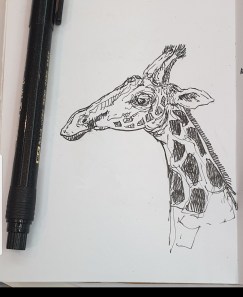
Another Sketch Challenge: Giraffe
This week sketch challenge @1hour1sketch is to Draw a Giraffe, so here is my sketch using pencil, black Pen. More Sketches on my Sketch page ..
By: Ali Radwani.
Python: Data Visualization Part-1
Learning : python, pygal, Data Visualization, Bar Chart
Subject: Data visualization using pygal library
pygal is a Data Visualization library in python to help us showing our Data as a graph. In coming several posts we will discover and learn how to use the pygal library in simple and easy configuration and style.
First we need to install pygal packeg, to do so write this:
pip install pygal
Now we need some Data to show, in this leson I am using aGalaxy Tab S4, so all the codes will be tested and applyed on trinket.io website [trinket.io alow us to use pygal package online so we don’t need to install it on our divice]
Type of Chart:
pygal has several types of charts that we can use, here we will list them all then in coming posts will use each one with simple data. So what we have:
Line, Bar, Histogram, XY, Pie, Radar, Box, Dot, Funnel, SolidGauge, Gauge, Pyramid, Treemap, Maps
Some of those charts has a sub-types such as in Bar char we have: Basic, Stacked and Horizontal. Also for each chart we can add a title and labels and we can use some styles.
So let’s start ..
First we will go for the Bar chart, and we have three sub-types as Basic, Stacked and Horizontal.
First chart: Bar chart:
In this part we will demonstrate the Bar Chart, it has three sub-types as Basic, Stacked and Horizontal.
We assume that our data is the Males and Female ages on first marage, the data will be as dictionary (later we will see how to customize each bar)
 # Basic Bar Chart using pygal

import pygal
bar_chart = pygal.Bar() # To create a bar graph object
bar_chart.add('Females', [22,25,18,35,33,18])
bar_chart.add('Males', [30,20,23,31,39,44])

bar_chart.title = "Males and Females First Marage Age"
bar_chart.x_labels=(range(1,6))

bar_chart.render()
Sample code for Basic bar chart |
Another sub-type in Bar chart is Horizontal-Bar, it is semelar to the Basic but as if fliped 90 degree. Here is the code ..
 # Horizontal Bar Chart using pygal

import pygal

# HorizontalBar()
HBar = pygal.HorizontalBar()
HBar.add('Females', [22,25,18,35,33,18])
HBar.add('Males', [30,20,23,31,39,44])

HBar.title = "Males and Females First Marage Age"

HBar.x_labels=(range(1,6))

HBar.render()
Sample code for Horizontal Bar chart |
Last sub-type in Bar chart is Stacked Bar were all data of each element will be in one bar. Here is the code and example..
 # Stacked Bar Chart using pygal

import pygal
# StackedBar()
stackedbar = pygal.StackedBar()
stackedbar.add('Females', [22,25,18,35,33,18])
stackedbar.add('Males', [30,20,23,31,39,44])
stackedbar.x_labels=(range(1,0))
stackedbar.title = "Males and Females First Marage Age"

stackedbar.render()
If we say we have another data-set as “age in First-Divorces” and we want to add this set to the Stacked Bar chart, then we first will create the data-set as:
stackedbar.add(‘Divorses’, [35,22,45,33,40,38])
and we will arrange the code line to be at top,middle or bottom of the bar. Here is the code..
Sample code for stacke Bar chart with Divorce data
|
Next we will talk about Line chart.
:: Data Visualization using pygal ::
| Part-1Bar-Chart | Part-2 | Part-3 | Part-4 |
By: Ali Radwani
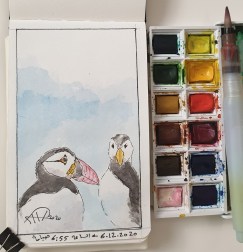
Another Sketch Challenge: Puffin
This week sketch challenge @1hour1sketch is to Draw a Puffin, so here is my sketch using pencil, Pen and water color..

Taking pictures is not my main daily practices, but when i start playing with my camera, i really enjoy my self.
Thanks for visiting my Space..


 Ali's Photography Space...