Archive
Python: Pandas Lesson 4
Learning : Panda Lesson 4
Subject: DataFrame Columns: Hide, Drop, rename
We still workinng on dataframe and columns, we will go thrght some function and at the end I will just add a line to save the dataframe in a new CSV file. So let’s start.
We still working on our data_file_zoo.csv and here i am copying the column we have in the file or in our df.
print(‘\n\n Columns in thedataFrame..\n’,df.columns)

|
Now we have a list of columns in our DataFrame, some time we want to hide a column, here we will creat a variable and whenever we call this variable the column will not be shone on the screen.
Hide column ‘supervisor’
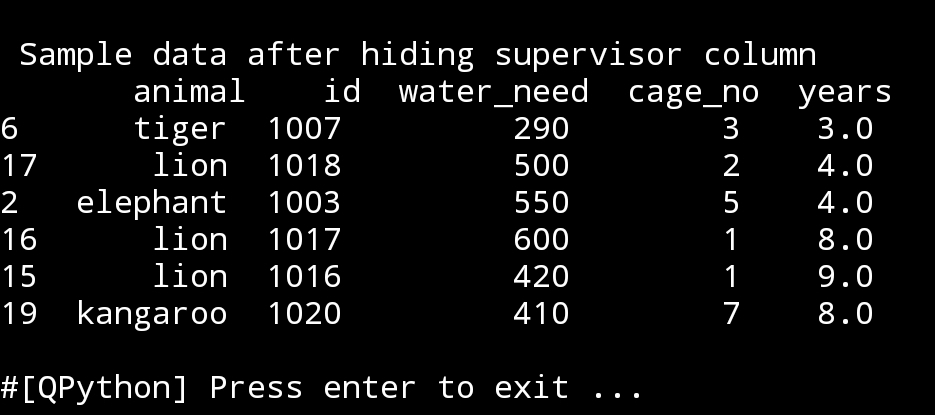
In this line we will set a variable to hide supervisor column, and just for sceen-shop we will present 6 random rows
hide_supervisor=df.drop([‘supervisor’], axis=1)
print(‘\n\n Sample data after hiding supervisor column\n’,hide_supervisors.sample(6))
|
In the upper case, we may have a password column or some key information column that we don’t want to be shown in the dataframe, then it’s good idea to create a DataFrame without this column an use it.
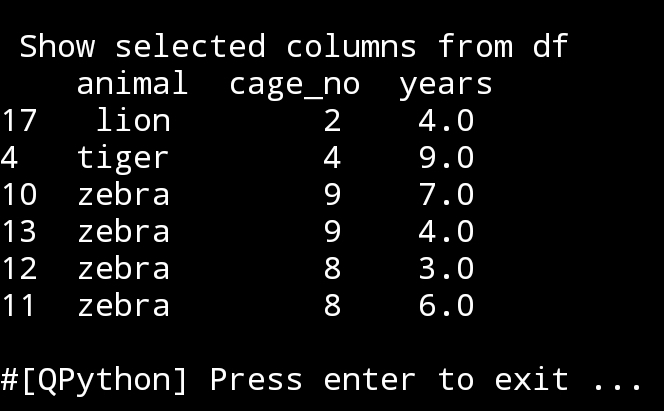
If we have a dataframe and we are examining some thing and don’t want to show all columns every time we print the df, so just show (say three) columns. To do this, first we will print the columns names so we know what we have in the df, then using coming code we will select whatever we want to show.
animal_cage_years=df[[‘animal’,’cage_no’,’years’]]
print(‘\n\n Show selected Columns from df\n’,animal_cage_years.sample(6))
|
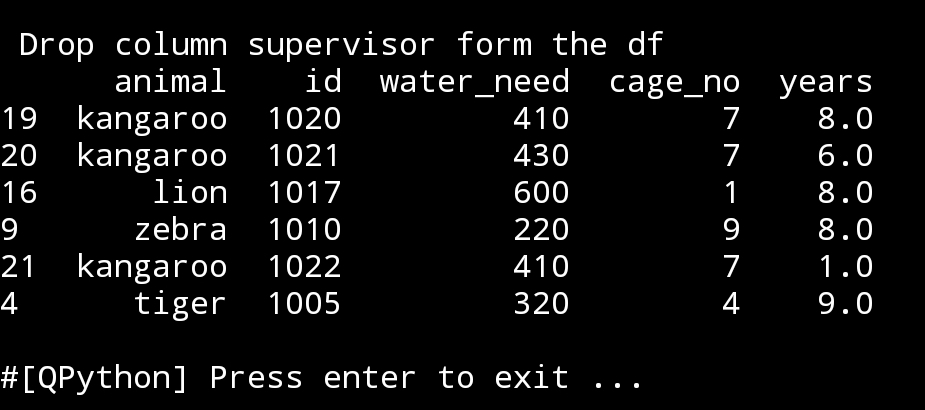
Now we will drop a column from the df, I will select ‘supervisor’, just like this:
print(‘\n\n Drop column ”supervisor” form the df’)
print(df.drop([‘supervisor’],axis=1))
|
To be Aware: In the above case, if we use the command on df and we add inplace=True then this will change the df, so any time we calling the df it will be without the ‘supervisor’ column. Here is the code..
df.drop([‘supervisor’], inplace=True, axis=1)
print(‘\n\n’,df)
If we want to hide more than one columns we just add them in the command like this:
hide_years_cages=df.drop([‘years’,’cage_no’], axis=1)
print(hide_years_cages.sample(6))

|
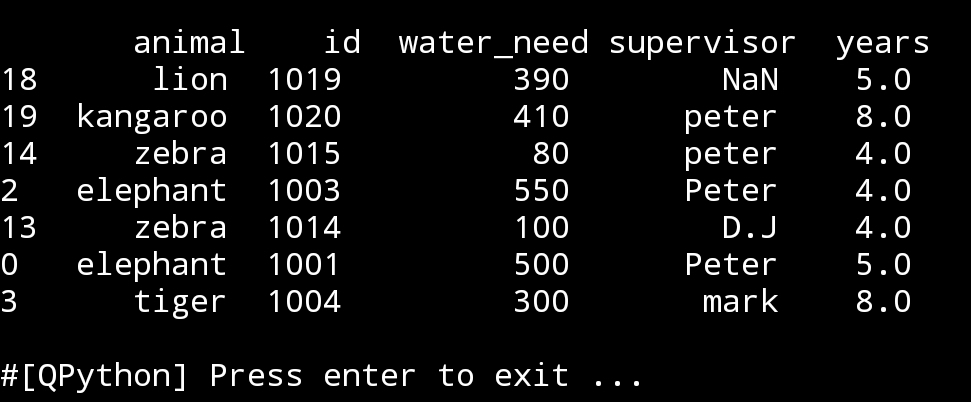
If we want to check wither or not a df contain column c_name if yes hide-it else print ‘Column not found’.
If column ‘cage_no’ in df hide it.
if ‘cage_no’ in df.columns:
hide_cage = df.drop([‘cage_no’], axis=1)
print(‘\n\n’,hide_cage.sample(6))
else:
print(‘Column not found’)
and we can in the else block just showing another dataframe.
|
:: Pandas Lessons Post ::
| Lesson 1 | Lesson 2 | Lesson 3 | Lesson 4 |
| Lesson 5 |
 Follow me on Twitter..
Python: Pandas Lesson 3
Learning : Pandas Lesson 3
Subject: dataframe (sort, where and filters)
In my Last post Pandaas Lesson 2, we show some commands that will output part of our dataframe (df) such as if we want to output the information we have about lions, or other animals in the Zoo file. Or to see what aminals fell under particular supervisor. Also I try to add a print statment over each output table to show/describe the table content.
In theis Lesson, or let’s say in this post I will share another bunch of commands dealing with one table of data. We will keep using our Zoo data file. So first I wll call the dataframe df.
import pandas as pd
file_name=’data_file_zoo.csv’
df=pd.read_csv(file_name, delimiter=’,’)
print(‘\n Data from Zoo file..’,df)
So, if we want to sort the data based on supervisor name.
df.sort_values(‘supervisor’, inplace=True)
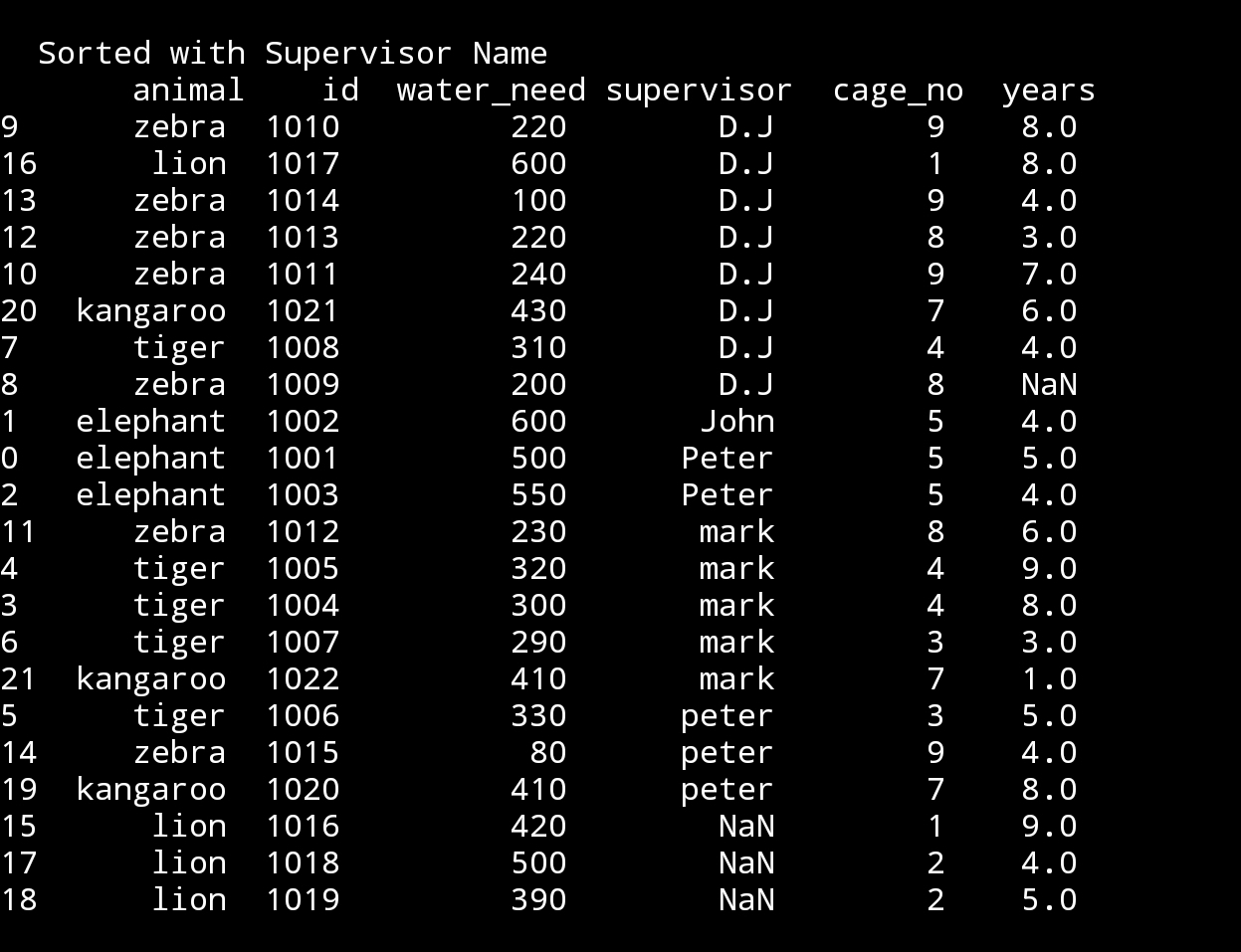
print(‘\n\n Sorted data with Supervisor Name\n’,df)
|
First thing to notes that we have two group of supervisors name ‘peter’ one with small ‘p’, another with Big ‘P’. Another thing to see that we have some ‘lions’ with NaN under supervisor, this meas there is no data in that feilds. I will not change this now, let’s do this in another lesson.
So, let’s sort the data now with anumal type.
df.sort_values(‘animal’,inplace=True)
print(‘\n\n Sort with animal type.\n’,df)
 |
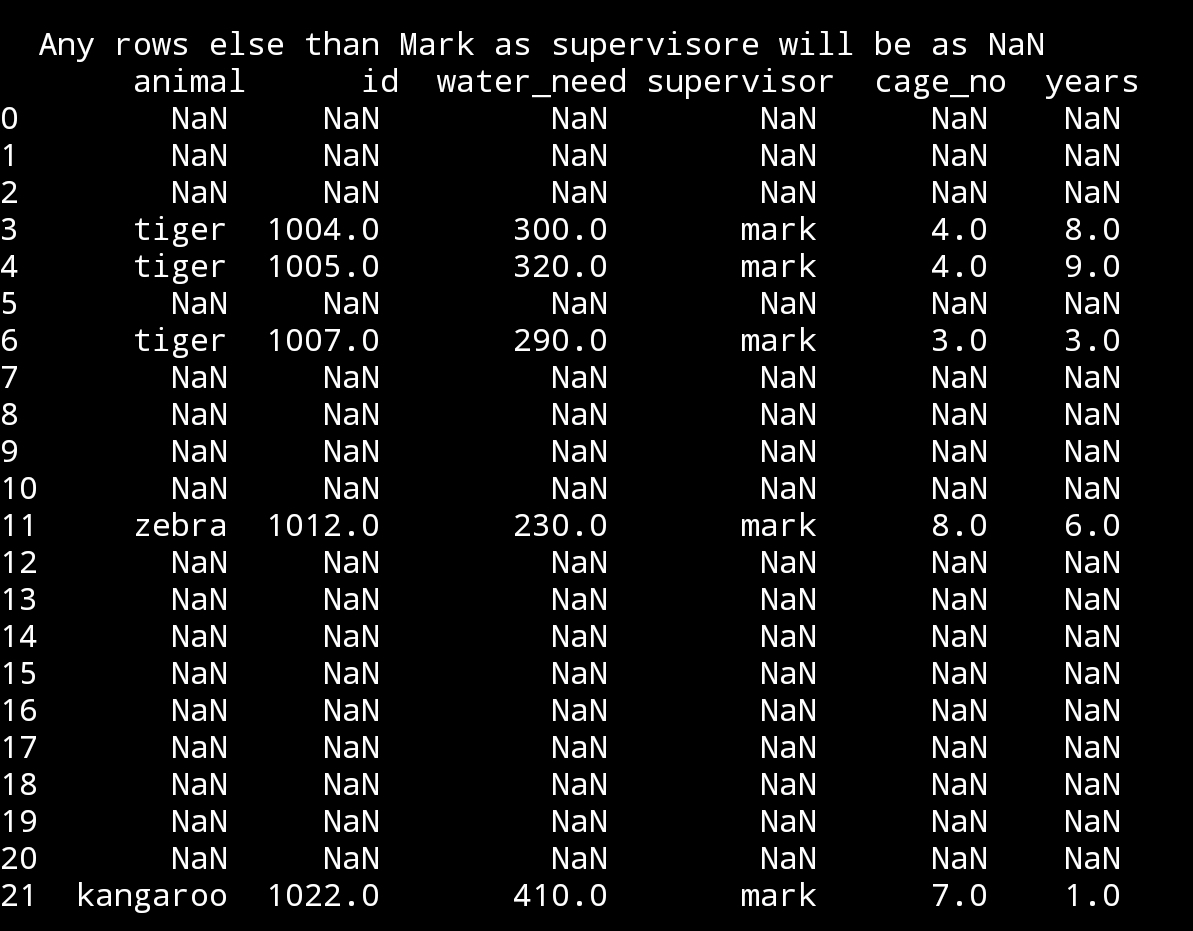
If we want to print all animal data under mark supervision, other data will be shown as NaN.
mark_supervision = df[‘supervisor’]==’mark’
df.where(mark_supervision, inplace = True)
print(‘\n\n Any rows else than Mark as supervisore will be as NaN\n’,df)
|
If we want to add another filter to the upper dataframe to show animals under mark supervision if the animal age is more than 7.
age_biger_7 = df[‘years’] >7
df.where(mark_suoervision & age_biger_7, inplace = True)
print(‘\n\n Only rows under mark supervision if animal age > 7 \n’,df)

|
:: Pandas Lessons Post ::
| Lesson 1 | Lesson 2 | Lesson 3 | Lesson 4 |
| Lesson 5 |
Python: Pandas Lesson
Learning : DataFrame and some commands
Subject: Pandas printing selected rows
First thing we will do today, we will add another coloumn to our CSV data_file_zoo.csv, we will add ‘years’ this will be hwo old each animal in the zoo is.
File_Name: data_file_zoo.csv
animal,id,water_need,supervisor,cage_no,years
elephant,1001,500,Peter,5,5
elephant,1002,600,John,5,4
elephant,1003,550,Peter,5,4
tiger,1004,300,mark,4,8
tiger,1005,320,mark,4,9
tiger,1006,330,peter,3,5
tiger,1007,290,mark,3,3
tiger,1008,310,D.J,4,4
zebra,1009,200,D.J,8,
zebra,1010,220,D.J,9,8
zebra,1011,240,D.J,9,7
zebra,1012,230,mark,8,6
zebra,1013,220,D.J,8,3
zebra,1014,100,D.J,9,4
zebra,1015,80,peter,9,4
lion,1016,420,,1,9
lion,1017,600,D.J,1,8
lion,1018,500,,2,4
lion,1019,390,,2,5
kangaroo,1020,410,peter,7,8
kangaroo,1021,430,D.J,7,6
kangaroo,1022,410,mark,7,1
As we just update out file, we need to load it to the memory by calling the df (dataframe), this will happen once we run our code.
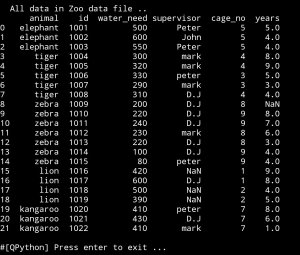
Here is a screen shot of the new data using print(df)
Lets say we want to know how many animals are numder 6 years. Here we will use df.loc to locate what we are looking for.
age_less_6 = df.loc[(dfyears<6)]
# To print we may use this:
print(‘ we have {} animals less than 6 years’.format(len(age_less_6)))
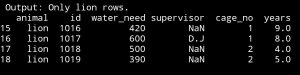
Now, we want to print only lion rows:
lino_rows = df.loc[(df.animal==’lion’)]
 Here is only rows with animal name ‘elephants’:
elephant_rows=df.loc[(df.animal==’elephant’)]
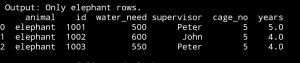
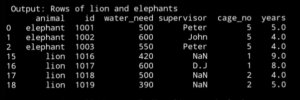
Now let’s print only the rows with lion and elephants:lion_and_elephant = df.loc[(df.animal==’lion’) | (df.animal == ‘elephant’)]
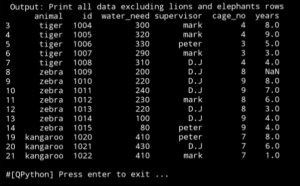
What if we want all the data but not the rows with lino or elephant.
all_exclude_lion_elephant=df.loc[(df.animal !=’lion’) & (df.animal !=’elephant’)]
:: Pandas Lessons Post ::
| Lesson 1 | Lesson 2 | Lesson 3 | Lesson 4 |
| Lesson 5 |
Python: Pandas Lessons
Learning : DataFrame and some commands
Subject:
This is my first hours in Pandas, until now thing are going smooth. I am using pythonanywhere on my PC, and jupyterlab on my galaxy tab S4.
In this post and coming once under name Pandas Lesson I will write some commands and what-ever I think I may need.
So, first thing we need a csv file with data to play with, so I search for some thing simple, i found one with zoo data!, I add two new column to it. so lets see it.
File_Name: data_file_zoo.csv
animal,id,water_need,supervisor,cage_no
elephant,1001,500,Peter,5
elephant,1002,600,John,5
elephant,1003,550,Peter,5
tiger,1004,300,mark,4
tiger,1005,320,mark,4
tiger,1006,330,peter,3
tiger,1007,290,mark,3
tiger,1008,310,D.J,4
zebra,1009,200,D.J,8
zebra,1010,220,D.J,9
zebra,1011,240,D.J,9
zebra,1012,230,mark,8
zebra,1013,220,D.J,8
zebra,1014,100,D.J,9
zebra,1015,80,peter,9
lion,1016,420,,1
lion,1017,600,D.J,1
lion,1018,500,,2
lion,1019,390,,2
kangaroo,1020,410,peter,7
kangaroo,1021,430,D.J,7
kangaroo,1022,410,mark,7
I add the ” supervisor and cage_no ” to the original file so we will have more room to manipulate.
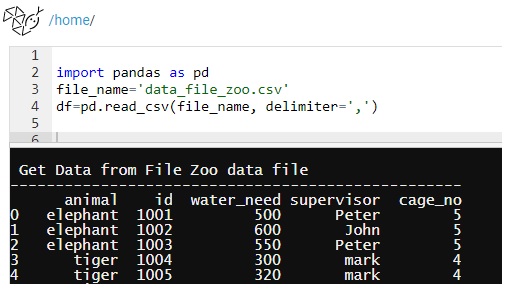
First Command: first thing we need to call pandas library using import, and set the file name and dataframe.
import pandas as pd
file_name=’data_file_zoo.csv’
df=pd.read_csv(file_name, delimiter=’,’)
We will use this part for all our initialization part
|
Other Command: Here are other commands that works with dataframe df.
| print(df) | Will print out all the data from the file. |
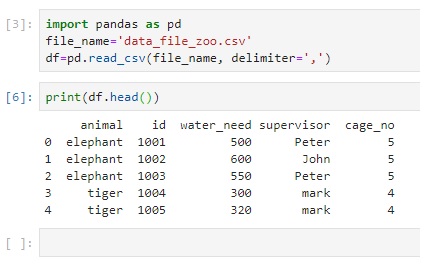
| print (df.head()) | Will print first 5 rows |
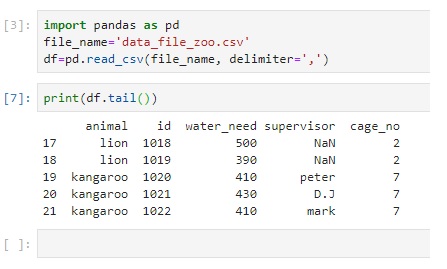
| print (df.tail()) | Will print last 5 rows |
| print (df.sample(3)) | Will print random 3 rows from the dataframe. |
| print(df.columns) | Will print the columns in the file |
| print (df[[‘id’,’animal’,’cage_no’]]) | Print only the data from column you want |
| print (df[[‘id’,’animal’,’cage_no’]].sample(3)) | Print random 3 rows of only ‘id’,’animal’,’cage_no’ columns |
| print (df[df.animal==’lion’]) | Get all the rows with animal name = lion . case sensitive |
| print(df.head()[[‘animal’,’id’]]) | Print first five rows of only animal and id |
 |
 |
 |
 |
 |
Wrapped up: This is a step one, pandas has many to read about and to learn, I start this initiative just for my self, and i select the hard way to do this, this is not important to my current job, this is nothing that any body will ask me about, but i want to learn and I think i will go further in this self-taught learning sessions..
———————————
Update on: 29/7/2019
:: Pandas Lessons Post ::
| Lesson 1 | Lesson 2 | Lesson 3 | Lesson 4 |
| Lesson 5 |
Python: Triangle, Pentagonal, and Hexagonal
Python: Triangle, Pentagonal, and Hexagonal
Problem No.45 @ Projecteuler
Completed on: Thu, 11 Jul 2019, 21:31
Another straight-forward problem, in this task I create three functions each for Triangle, Pentagonal, and Hexagonal and we return the value of the formulas as been stated in the problem.
Using a for loop and a number range, I store the results in a list tn, pn, hn. then comparing the values in the three lists searching for same value.

|
The Code:
# P45
# Solved
# Completed on Thu, 11 Jul 2019, 21:31
def tn (n) :
return int(n*(n+1)/2)
def pn(n):
return int(n*(3*n-1)/2)
def hn (n):
return int(n*(2*n-1))
tn_list =[]
pn_list=[]
hn_list=[]
n = 0
# Notes: I run the code for large range, but to save more time after 5000 i select +10,000 each time.
for n in range (5000,60000):
tn_list.append(tn(n))
pn_list.append(pn(n))
hn_list.append(hn(n))
print ([x for x in tn_list if x in pn_list and x in hn_list])

|
Python: Smallest Multiple
Python: Smallest multiple
Problem 5 @ projecteuler
Completed on: Thu, 4 Jul 2019, 22:30
Here I am quoting form ProjectEuler site:”
2520 is the smallest number that can be divided by each of the numbers from 1 to 10 without any remainder. What is the smallest positive number that is evenly divisible by all of the numbers from 1 to 20?”
So to solve this simple task all we need to loop through numbers and divide it by a list of (1,20) if yes return True otherwise return False and got to another number.
and so we done..

|
The Code:
codes here

|
Python: Powerful Digit Counts
Python: Powerful Digit Counts
Problem No.63 @ ProjectEuler
Completed on: Completed on Thu, 11 Jul 2019, 17:21
Just to make my post simple, i am quoting from ProjectEuler page
The 5-digit number, 16807=75, is also a fifth power. Similarly, the 9-digit number, 134217728=89, is a ninth power.
How many n-digit positive integers exist which are also an nth power?
Then, we need to find the loop that will solve this, and we did..
|
|

The Code:
# P63
# Power digit count
# Solved
# Completed on Thu, 11 Jul 2019, 17:21
c = 0
for x in range (1,50):
for p in range (1,50) :
if (len(str(x**p)) == p ):
c += 1
print(‘\n We have {} n-digit integers exist which are also an nth power.’.format(c))
Python: Pentagon Numbers
Python: Pentagon Numbers
Problem No.44 on ProjectEuler
Completed on: Thu, 11 Jul 2019, 18:37
This problem talking about the Pentagonal numbers and gives us a formula. Using that formula for a certain range of numbers, the generated sequence showing that P4 + P7 = 22 + 70 = 92, 92 is the P8, but if we subtracting (P7 – P4) = 70 – 22 = 48, 48 is not in the generated sequence of pentagonal numbers, so 48 is not pentagonal.
The task here is to find the pair of pentagonal Pj,Pk which their sum and difference are Pentagonal D = Pk – Pj is minimised.(we need to get the D).

|
The Code:
# P44
# Pentagon Numbers
# Solved
#Completed on Thu, 11 Jul 2019, 18:37
def pn(n):
return int(n*(3*n-1)/2)
pn_list=[]
for n in range (1000,3000) : # I start increasing the range step by step.
pn_list.append(pn(n))
we_found_it = False
for x in range (0,len(pn_list)-1) :
px= pn_list[x]
for y in range (x+1,len(pn_list)-1) :
py= pn_list[y]
if (px+py) in pn_list:
if (py-px) in pn_list:
print(‘\n We found one ‘,px,py,’D = ‘,py-px )
we_found_it = True
if we_found_it : break
print(‘Done’)
|
|

Python is_prime and time consuming
Python: is_prime and time consuming
Function enhancement
Once i start solving projectEuler problems i notes that i need the prime numbers in most of cases, so I wrote a function called ‘is_prime’ and it works fine. Some time just to get all the primes in a given range takes some seconds, seconds in computer time means waiting a lot. With some other problems that we need to get the prime in large numbers my function looks slow, since I am not deep in math I search the net for a better way to get the primes or to check if a given number is prime or not.
Definition A prime number (or a prime) is a natural number greater than 1 that cannot be formed by multiplying two smaller natural numbers. wikipedia.org. So as I understand a prime number is not dividable by any other numbers, so my is_prime function is taking a number let’s say n= 13, and start a loop from 2 to n=13 if we fond a number that divide 13 then 13 is not a prime.
Here is the code:
def is_prime1(num):
for t in range (2, num):
if num % t == 0 :
return False
return True
The function is working fine and we can get the prime numbers, but as I mention above, if we have a large number or a wide range, this will take some time. After searching the web, I found some facts regarding the Prime Numbers:
1. The only even prime number is 2. (So any other even numbers are not prime)
2. If the sum of a number digits is a multiple of 3, that number can be divided by 3.
3. No prime number greater than 5 ends in/with 5.
OK, now I can first cut any range to half by not going through even numbers (if even false). Then, I will see if the number end with 5 or not (if end with 5 false),last I will do a summation of the digits in the number if the sum divide by 3 (if yes false), and if the number pass then i will take it in the loop from 5 to n, and if any number divide it we will return false.
Here is the code after the enhancement:def is_prime2(num):
if num %2==0 : # pass the even numbers.
return False
num_d= str(num) # if last digits is 5, then not prime
t= len(num_d)
if (num_d[t-1]) == 5 :
return False
tot = 0
for each in str(num):
tot = tot + int(each)
if tot % 3 == 0 : # if digits sum divide by 3, then not prime
return False
for t in range (3, num, 2):
if num % t == 0 :
return False
return True
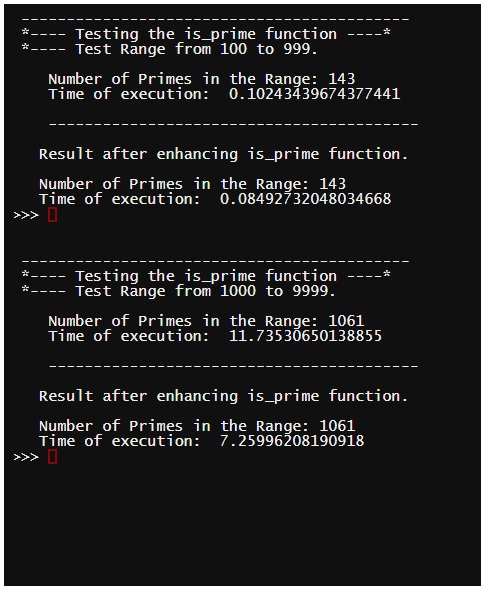
I test both function on my laptop, for different number ranges, and use the time function to see the time delays with each one. Here is the results. If any one know better way to do this please drop it here. Or on My Twitter.
|
Python: Largest Palindrome Product
Python: Largest Palindrome Product
Problem No.4 @ Projecteuler
Complete on: on Fri, 5 Jul 2019, 08:53
The task was to find the largest palindromic number that been generated from multiplying two of 3 digits number.
Definition: Palindromic numbers are numbers that remains the same when its digits are reversed. Like 16461, we may say they are “symmetrical”.wikipedia.org
To solve this I first wrote a function to check if we can read a number from both side or not, Then using while and for loop through numbers 100 to 999, and store largest palindromic, we select the range (100,999) because the task is about tow number each with 3 digits.

|
The Code:
# Problem 4
# Largest palindrome product
# SOLVED
# Completed on Fri, 5 Jul 2019, 08:53
palin =0
def palindromic(n) :
n_list=[]
for each in str(n) :
n_list.append(each)
n_last = len(n_list)-1
n_first =0
x=0
while (n_first+x != n_last-x) :
if n_list[n_first+x] != n_list[n_last-x] :
return False
else :
x +=1
if (n_first +x > n_last -x):
return True
return True
for set1 in range (1,999):
for set2 in range (set1,999):
if palindromic(set1 * set2) :
if (set1 * set2) > palin :
palin =(set1*set2)
print(‘\n We found it:’,palin, ‘coming from {} * {}’.format(set1,set2))

|

Taking pictures is not my main daily practices, but when i start playing with my camera, i really enjoy my self.
Thanks for visiting my Space..


 Ali's Photography Space...