Archive
Python is_prime and time consuming
Python: is_prime and time consuming
Function enhancement
Once i start solving projectEuler problems i notes that i need the prime numbers in most of cases, so I wrote a function called ‘is_prime’ and it works fine. Some time just to get all the primes in a given range takes some seconds, seconds in computer time means waiting a lot. With some other problems that we need to get the prime in large numbers my function looks slow, since I am not deep in math I search the net for a better way to get the primes or to check if a given number is prime or not.
Definition A prime number (or a prime) is a natural number greater than 1 that cannot be formed by multiplying two smaller natural numbers. wikipedia.org. So as I understand a prime number is not dividable by any other numbers, so my is_prime function is taking a number let’s say n= 13, and start a loop from 2 to n=13 if we fond a number that divide 13 then 13 is not a prime.
Here is the code:
def is_prime1(num):
for t in range (2, num):
if num % t == 0 :
return False
return True
The function is working fine and we can get the prime numbers, but as I mention above, if we have a large number or a wide range, this will take some time. After searching the web, I found some facts regarding the Prime Numbers:
1. The only even prime number is 2. (So any other even numbers are not prime)
2. If the sum of a number digits is a multiple of 3, that number can be divided by 3.
3. No prime number greater than 5 ends in/with 5.
OK, now I can first cut any range to half by not going through even numbers (if even false). Then, I will see if the number end with 5 or not (if end with 5 false),last I will do a summation of the digits in the number if the sum divide by 3 (if yes false), and if the number pass then i will take it in the loop from 5 to n, and if any number divide it we will return false.
Here is the code after the enhancement:def is_prime2(num):
if num %2==0 : # pass the even numbers.
return False
num_d= str(num) # if last digits is 5, then not prime
t= len(num_d)
if (num_d[t-1]) == 5 :
return False
tot = 0
for each in str(num):
tot = tot + int(each)
if tot % 3 == 0 : # if digits sum divide by 3, then not prime
return False
for t in range (3, num, 2):
if num % t == 0 :
return False
return True
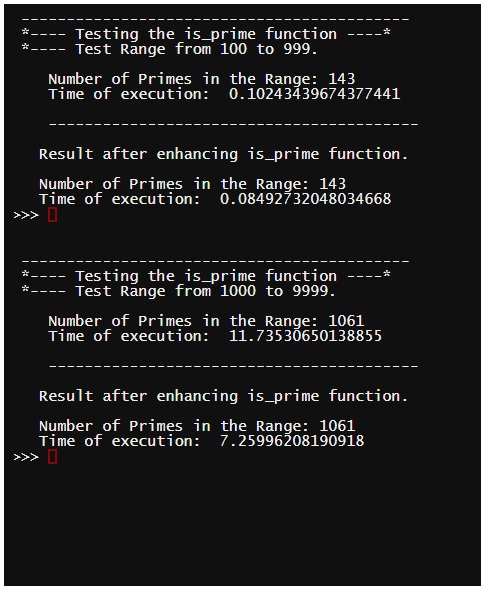
I test both function on my laptop, for different number ranges, and use the time function to see the time delays with each one. Here is the results. If any one know better way to do this please drop it here. Or on My Twitter.
|
 Follow me on Twitter..
Python: Largest Palindrome Product
Python: Largest Palindrome Product
Problem No.4 @ Projecteuler
Complete on: on Fri, 5 Jul 2019, 08:53
The task was to find the largest palindromic number that been generated from multiplying two of 3 digits number.
Definition: Palindromic numbers are numbers that remains the same when its digits are reversed. Like 16461, we may say they are “symmetrical”.wikipedia.org
To solve this I first wrote a function to check if we can read a number from both side or not, Then using while and for loop through numbers 100 to 999, and store largest palindromic, we select the range (100,999) because the task is about tow number each with 3 digits.

|
The Code:
# Problem 4
# Largest palindrome product
# SOLVED
# Completed on Fri, 5 Jul 2019, 08:53
palin =0
def palindromic(n) :
n_list=[]
for each in str(n) :
n_list.append(each)
n_last = len(n_list)-1
n_first =0
x=0
while (n_first+x != n_last-x) :
if n_list[n_first+x] != n_list[n_last-x] :
return False
else :
x +=1
if (n_first +x > n_last -x):
return True
return True
for set1 in range (1,999):
for set2 in range (set1,999):
if palindromic(set1 * set2) :
if (set1 * set2) > palin :
palin =(set1*set2)
print(‘\n We found it:’,palin, ‘coming from {} * {}’.format(set1,set2))

|
Python: Champernowne’s constant
Python: Champernowne’s constant
Problem No.40 @ ProjectEuler
Completed on: Mon, 1 Jul 2019, 18:01
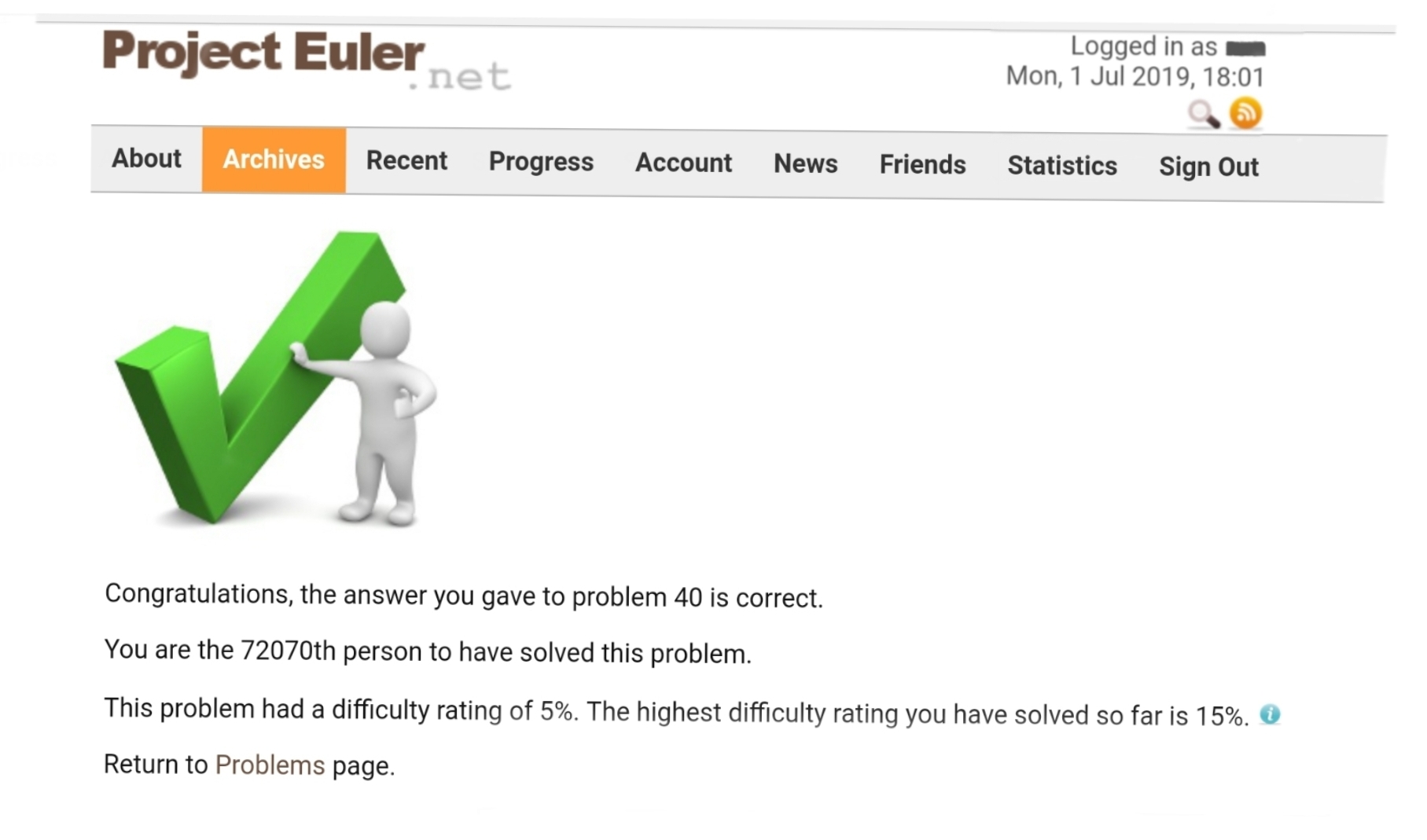
In This task No.40, basically we need to get some digits from a large decimal fraction, then finding the multiplication of those digits.
ProjectEuler assume that the fraction is: 0.123456789101112131415161718192021222324 …. until 1000000, then we should fined the digits in positions 1, and 10, 100, 1000, 10000, 100000 and 1000000. Here is a copy of the problem screen

|
So to solve this I create a string variable n_list then using for loop i store the numbers from 1 to 1000000 in it as [12345678910111213141516 … 1000000], and simply get the digits I want using the list index, and Finally I calculate the needed multiplication as required. .. And we solve it. ..
|
Python: Combinatoric Selections
Python: Combinatoric Selections
Problem 53 @ projecteuler
Completed on: Mon, 1 Jul 2019, 11:32
This is one of the tasks that based on equations. To solve this, first let me Simplify it.
Simplifying the task:
if 1<= n <= 100 , and r <= n
using the equation of C(n,r) is
c(n,r) = n! / (r! *(n-r)!
How many values of c(n,r) greater than one-million
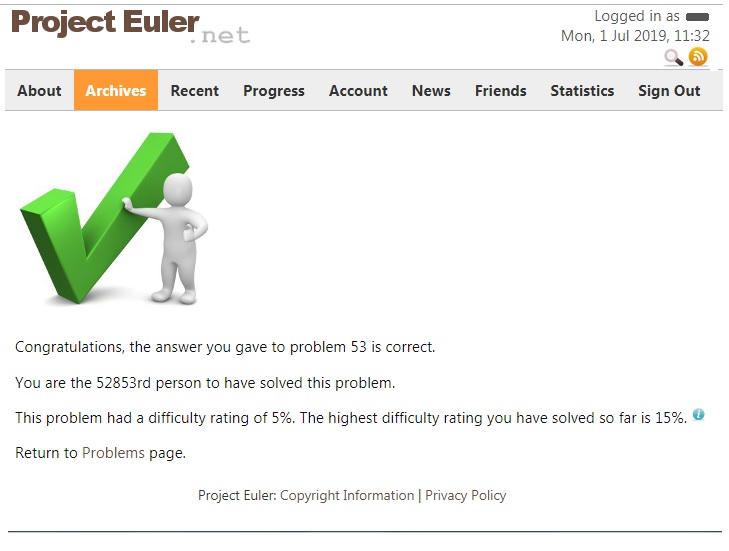
Since we need the factorial of n (n!) and (r!) then I will re-use our function get_factorial(num), and I will write another function to calculate the C(n,r) as in the equation above, I will call it combi(n,r), also I will use a while loop, and we need to set some variables to help us in the execution. In this part, I will use a list called values_over_1m to store all the values in it, although this is Not required in the Problem 53, but i will keep it so later we can print them all to the screen or just get the total values of it. And so we did .. and we get the right answer.
|
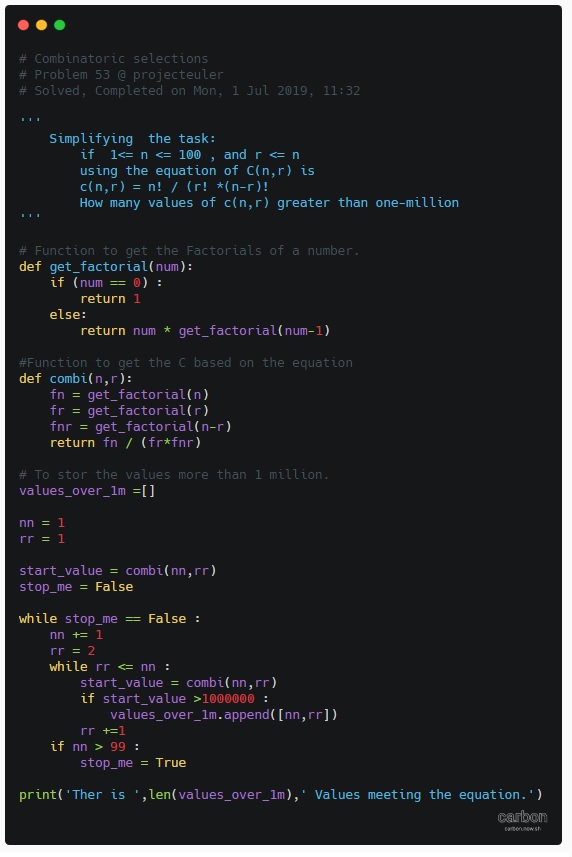
The Code:
# Combinatoric selections
# Problem 53 @ projecteuler
# Completed on Mon, 1 Jul 2019, 11:32
”’
if 1<= n <= 100 , and r <= n
using the equation of C(n,r) is
c(n,r) = n! / (r! *(n-r)!
How many values of c(n,r) greater than one-million
'''
# Function to get the Factorials of a number.
def get_factorial(num):
if (num == 0) :
return 1
else:
return num * get_factorial(num-1)
def combi(n,r):
fn = get_factorial(n)
fr = get_factorial(r)
fnr = get_factorial(n-r)
return fn / (fr*fnr)
# To store the values more than 1 million.
values_over_1m =[]
nn = 1
rr = 1
start_value= combi(nn,rr)
stop_me = False
while stop_me == False :
nn +=1
rr =2
while rr < = nn :
start_value = combi(nn,rr)
if start_value >1000000 :
values_over_1m.append([nn,rr])
rr +=1
if nn > 99 :
stop_me = True
print(‘Ther is ‘,len(values_over_1m),’ Values meeting the equation.’)
|
Python: Permuted Multiples
Python: Permuted Multiples
Problem No.52 @ Projecteuler
This task Completed on Mon, 1 Jul 2019, 06:08, the goal is to find a number X that if we get the X, X*2, X*3, X*4, X*5, X*6 all the numbers are same digits but in a different order.
I use a function called if_x_in_y (n1,n2) will return True if the two numbers has same digits, False if not. Then a while found_one is not True a loop will examine all numbers starting from 2 until we found_one.
|
The Code:
# Projecteuler.net
# Permuted multiples
# Problem No.52
# Completed on Mon, 1 Jul 2019, 06:08am (GMT+3)
# if x, x*2, x*3, x*4, x*5, x*6 has the same digits.
def if_x_in_y (n1,n2) :
for x in str(n1) :
if x not in str(n2) :
return False
for x in str(n2):
if x not in str(n1):
return False
return True
x_num = 2
found_one= False
while not found_one:
if if_x_in_y(x_num,x_num*2):
if if_x_in_y(x_num,x_num*3):
if if_x_in_y(x_num,x_num*4):
if if_x_in_y(x_num,x_num*5):
if if_x_in_y(x_num,x_num*6):
print(‘\n Yes, we found one ..’)
found_one = True
print(‘ The Number is ‘,x_num)
x_num += 1
print(x_num,x_num*2,x_num*3,x_num*4,x_num*5,x_num*6)

|
Python: Number Letter Counts
Python: Number Letter Counts
Problem 17, Projecteuler
For problem 17, projectEuler ask for the total numbers of alphabetics in all words of numbers from 1 to 1000.
Here I am coping from there page.
Once I read the task, I decide to create my own version of the requirement. I start to assume that I may have a dictionary with some numbers and words, then base on what ever the user will input (number between 1 and 999) then I shall convert it to words.
Example:
1 –> one
8 –> eight
234 –> tow hundred thirty-four .. and so on.
I start searching the net to get the words I need, and store them in 3 dictionaries.
num_1_9 = {“1″:”one”,”2″:”two” .. ext.
num_10s = {“10″:”ten”,”20″:”twenty” .. ext.
num_11s = {“11″:”eleven”,”12″:”twelve”.. ext
Then, I start writing the functions for each group of numbers/dictionaries, so if the user enter a number we will read number of digits if it is 1 then we call def num_1_d(), if it is 2 digits we call def num_2_ds() and if it is 3 digits we call num_3_ds(). At the end, we got the right answer for Projecteuler, and here is the code in my way, I am asking the user to enter a number then i convert it to a corresponding words.
|
The Code:
# Date:27/6/2019
# ProjectEuler
# Problem No.17
# Completed on Sun, 30 Jun 2019, 10:30
num_1_9 = {“1″:”one”,”2″:”two”,”3″:”three”,”4″:”four”,”5″:”five”,”6″:”six”,”7″:”seven”,”8″:”eight”,”9″:”nine”}
num_11s={“11″:”eleven”,”12″:”twelve”,”13″:”thirteen”,”14″:”fourteen”,”15″:”fifteen”,”16″:”sixteen”,”17″:”seventeen”,”18″:”eighteen”,”19″:”nineteen”}
num_10s ={“10″:”ten”,”20″:”twenty”,”30″:”thirty”,”40″:”forty”,”50″:”fifty”,”60″:”sixty”,”70″:”seventy”,”80″:”eighty”,”90″:”ninety”}
num_100=’hundred’
def num_1_d(num):
if len(str(num)) == 1:
return num_1_9[str(num)]
def num_2_ds(num):
d0,d1 = num[0], num[1]
if int(num[1])== 0 :
return num_10s[str(num)]
elif int(num[0]) == 1 :
return num_11s[str(num)]
elif (int(num[0])) >1 :
d0=str(d0)+str(0)
return ‘{}-{}’.format(num_10s[str(d0)],num_1_9[str(d1)])
def num_3_ds (num):
d0,d1,d2=num[0],num[1],num[2]
if (int(num[1])==0) and (int(num[2])==0) :
return ‘{} {}’.format(num_1_9[str(d0)],num_100)
elif (int(num[1])>0):
d1 = str(d1)+str(d2)
return ‘{} {} and {}’.format(num_1_9[str(d0)],num_100,num_2_ds(d1))
elif (int(num[1])==0) and (int(num[2])>0):
d1 = str(d1)+str(d2)
return ‘{} {} and {}’.format(num_1_9[str(d0)],num_100,num_1_9[str(d2)])
num =0
while num !=’f’ :
num =input(‘\nEnter a number: (1-999)’)
if len(str(num)) == 1:
print(num ,’ is ‘,(num_1_d(num)))
elif len(str(num)) == 2:
print (num ,’ is ‘,(num_2_ds(num)))
elif len(str(num)) == 3:
print (num ,’ is ‘,(num_3_ds(num)))
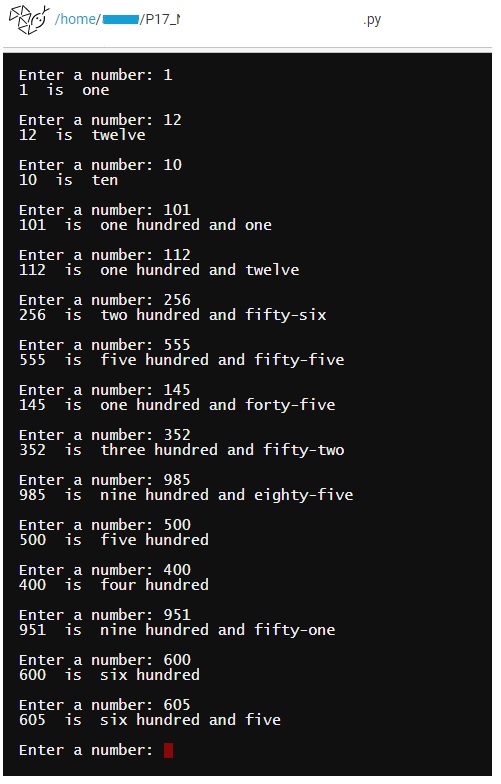
This is Output screen for my-way version
|
Python: 10001st Prime
Python: 10001st Prime
Problem No.7 @ ProjectEuler
This is one of shot projects you may find on ProjectEuler, the task is find the prime No 10001, I just run my is_prime function, if the number is prime will add 1 to the counter, until we reach 10001, that will be the answer.
|
The Code:
# 10001st prime
# Problem 7
# Solved: Wed, 26 Jun 2019, 05:57am (GMT+3)
def is_prime(num):
result = True
for t in range (2,num):
if num%t==0 :
result= False
break
return result
p_count=0
num =0
while p_count <=10001:
num +=1
if is_prime (num):
p_count +=1
print(p_count,num)
print(num,p_count-1)
|
|

Python: Largest Prime Factor
Python: Largest Prime Factor
Problem No.3 on ProjectEuler
Quite easy one to solve, in this task we need to get all the factors of a given number, then to print out the largest prime one.

|
|

To solve this with a Large Number I search the net and i fond an article explain it. So here i am putting it in points.
Factors of Large Numbers:
1. First ask if the number N is (Even or Odd)?
2. If the number N is Even, then factors=(2) then, the new N = N Divide by 2.
3. If the number N is Ood, then start form 3 and get/find smallest prime factors (SPF) of it.
4. Add the smallest prime factors to factors list.
5. Then, the new N = N Divide by smallest prime factors (SPF).
6. If the new N is Even goto line 2, If the new N is Odd goto line 3.
The Code:
# Largest prime factor
# Problem No.3
# Solved
def factors_of_n(num):
a=3
while a <= num:
if num%a==0:
return int(a)
break
a = a + 1
# This is the number from ProjectEuler
num = 600851475143
temp_num = num
facto_back =0
p_factors =[]
the_num=1
while temp_num > 1 :
if temp_num%2==0 :
p_factors.append(2)
temp_num = temp_num / 2
else:
facto_back =factors_of_n(temp_num)
p_factors.append(facto_back)
temp_num = temp_num / facto_back
print(p_factors)
print(‘\n Largest Prime Factor of {} is {}’.format(num,max(p_factors)))

|

Taking pictures is not my main daily practices, but when i start playing with my camera, i really enjoy my self.
Thanks for visiting my Space..


 Ali's Photography Space...