Archive
Python: Prime Numbers in Range
Python: Prime Numbers in a Range
Our task here is simple as the title, we will have a range and will test each number to see if it is a prime then we will add it to a list, once we finish we will print out the list.
To complete this task we will use one of our function we create last time (Read: is prime post).
So, here we will ask the user to input two numbers num1 and num2 the we will pass all the numbers in the range to is_prime() and store the result in a list.
The Code:
#Function to get all Prime numbers in a range.
#Ask the user to enter two numbers
print ‘Get all Prime numbers in a range\n’
num1=int(input(“Enter the first number in the range: “))
num2=int(input(“Enter the last number in the range: “))
#create the list
prime_list=[]
def get_all_prime(num1,num2):
for x in range (num1,num2):
if is_prime(x) ==’Prime’:
prime_list.append(x)
return prime_list
#Call the function and print the list
get_all_prime(num1,num2)
print prime_list
print len(prime_list)

 Follow me on Twitter..
Python Project: Sum of the Square and Square of the Sum
Python: Sum of the Square and Square of the Sum
Difference of sum of the square and the square of the sum
I fond this on projecteuler.net Usually I add some steps to there problems to make it more application look and feel. Later on, we’ll see how.
Problem assumption: If we said that we have a range of numbers (1,10) then the sum of this range is 1 + 2 + 3 + 4 + 5 + 6 + 7 + 8 + 9 + 10 = 55, Now the Square of the sum is 55^2; thats mean the Square of the sum of (55) = 3025.
And for the same range, the Sum of Square means that we will get the Square of each number in the range then will get there summation. So with our range (1,10) Sum of Square is 1^2 + 2^2 + 3^2 + 4^2 + 5^2 …. + 10^2 = 385
The Problem #6 in ProjectEuler
The sum of the squares of the first ten natural numbers is,12 + 22 + … + 102= 385
The square of the sum of the first ten natural numbers is,(1 + 2 + … + 10)2 = 552= 3025
Hence the difference between the sum of the squares of the first ten natural numbers and the square of the sum is 3025 − 385 = 2640.
The Task:Find the difference between the sum of the squares of the first one hundred natural numbers and the square of the sum.
Inhancment Now to make this task workking as application and to get more general output of it, first we will ask the user to input a range of the numbers, then we will applay the function on that range.
The Code:
# Problem 6 in ProjectEuler.
def square_of_sum(num1, num2):
tot = 0
for x in range(num1, num2+1):
tot = tot+x
print(‘The Square of the Sun’,tot*tot)
return tot*tot
def sum_of_square(num1, num2):
tot = 0
for x in range(num1, num2+1):
tot = tot+(x*x)
print(‘The Sum of the Square ‘, tot)
return tot
#Ask the user for his input.
num1 = int(input(‘Enter First number in the range: ‘))
num2 = int(input(‘Enter the last number in the range: ‘))
#Call the functions.
w1 = square_of_sum(num1, num2)
w2 = sum_of_square(num1, num2)
#Output the Difference.
print(‘The Difference is: ‘, w1-w2)

Python Project: Is it a Prime
Python: Prime Number
Is it Prime
In a simple way, a Prime number is a number that cannot be made by multiplying other numbers. So 4 is Not Prime because we can say that 4 = 2 x 2, 6 is Not Prime because it can be produced by multiplying 3 x 2; but 5 Is Prime because we can’t find any integer numbers that can produce 5.
Numbers such as 1, 3, 5, 7, 11, 13 … all are Prime Numbers.
This function will ask the user to write a number then we will examine it to see whether it is a prime or not.
The Code:
num=int(input(“Enter a number: “))
def is_prime(num):
result=”Prime”
for t in range (2,num):
if num%t==0 :
result=”Not Prime”
break
return result
print num,’is’,is_prime(num)

Python Project: Fibonacci Numbers
Python: Fibonacci Numbers
Even Fibonacci Numbers
Fibonacci Sequence is generated by adding the previous two terms, so the N number in the sequence will be Xn=(Xn-1) + (Xn-2). Example: by starting with 1 and 2, the first 10 terms will be: 1, 2, 3, 5, 8, 13, 21, 34, 55, 89, …
The Task: Get the Fibonacci sequence range from the user and count how many even valued terms is there. The user range should not be more than 10000 number.
The Code:
def get_Fibonacci_Sequence(rfrom,rto):
n1=rfrom
n2=rfrom+1
count=0
for x in range (rfrom,rto):
fab=n1+n2
n1=n2
n2=fab
# Check if the fab is even, the increment the counter
if fab%2==0 :
count =count +1
# After finish print the output
print”Between”,rfrom,” and “,rto,” there is “,count,”even Fibonacci number.”
range_ok =”no”
while range_ok==”no”:
print(‘Your range must be less than 10,000:’)
# Get the numbers from the user.
rfrom=int(input(‘Enter the range From:’))
rto=int(input(‘Enter the range To:’))
# Check if the numbers are less than 10000
if (rto – rfrom) < 10000 : range_ok ="yes"
#Call the function
get_Fibonacci_Sequence(int(rfrom),int(rto))

Python Project: Pluralise a Word
Python: Pluralise a Word
Loop through a dictionary and pluralise a word
One of Python Exercises on @PyBites codechalleng is to loop through a given dictionary of people and the number of games they’ve won then print out the users name and how many games they’ve won in the following format: “sara has won n games” and pluralise the word game to suit the number of games won.
we assume the dictionary is games_won = dict={‘sara’:0, ‘bob’:1, ‘tim’:5, ‘julian’:3, ‘jim’:1}
The Code:
games_won ={‘sara’:0, ‘bob’:1, ‘tim’:5, ‘julian’:3, ‘jim’:1}
def print_game_stats(games_won):
for key,val in games_won.items():
print(“{} has won {}{p}”.format(key, val,p=” game” if val ==1 else ” games” ))
print_game_stats(games_won)

Python Project: Binary Search
Python: Binary Search
Binary Search
Definition:
Binary Search is a search algorithm that finds the position of a target value within a sorted array. Binary search compares the target value to the middle element of the array.
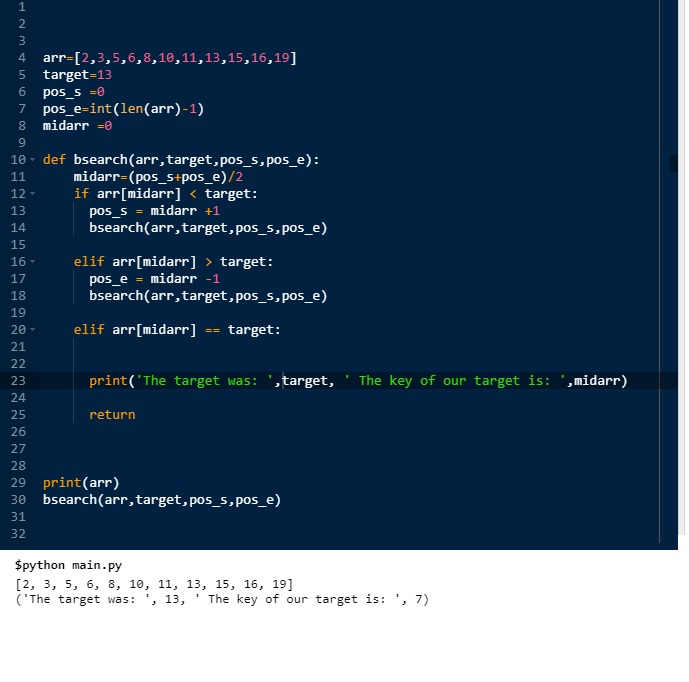
In this code we are writing a Python code to find the target in a sorted given array and get its position without using any python math packages.
The case: We have an Array (arr=[2,3,5,6,8,10,11,13,15,16,19]) our target is 13, so we want the position of 13.
We are setting the first position as (pos_s=0) and the end position as (pos_e= the length of the array -1) and we will use recursive function.
Recursive Function: is a computer function or procedure that calling it self
The Code:
arr=[2,3,5,6,8,10,11,13,15,16,19]
target=11
pos_s =0
pos_e=int(len(arr)-1)
midarr =0
def bsearch(arr,target,pos_s,pos_e):
midarr=(pos_s+pos_e)/2
if arr[midarr] < target:
pos_s = midarr +1
bsearch(arr,target,pos_s,pos_e)
elif arr[midarr] > target:
pos_e = midarr -1
bsearch(arr,target,pos_s,pos_e)
elif arr[midarr] == target:
print(‘The target was: ‘,target, ‘ The key of our target is: ‘,midarr)
return
print(arr)
# Call the functin
bsearch(arr,target,pos_s,pos_e)
Python code: Date Validation
Python: Date Validation
As in any application there is lots of functions and procedures helping the application, some of these functions are directly related to the menu bar other are there just to work on back ground to perform a task and return something that another function need to complete an action.
Here is a python code to ask the user to input a date and check if the date is in the format we want to be.
I am new in python so maybe there is a code or a function to perform this, so if any one can help in this.
#python code: Date Validation
def valid_date():
my_date=input(‘Enter the date as dd/mm/yyyy :’)
try:
d,m,y=(my_date.split(‘/’))
if len(d)==1: d=’0’+d
if len(m)==1: m=’0’+m
if len(y)==2: y=’20’+y
if int(d)>31: print(‘Day must be less then 31’), brake
if int(m)>12: print(‘Mounth must be less then 12’), brake
my_date=d+’/’+m+’/’+y
return my_date
except:
print(‘Enter a valid date.’)
return ‘false’
vd=valid_date()
if vd == ‘false’ : valid_date()
else:
print(‘OK’, vd)

Python: Expenditure App
Expenditure Application
In this post, we will go through the case study of our application.
‘ The Case’
We want to build an application to store and retrieve some data regard our expenditure, we will go as simple as two keys (date and amount), and we will save the data in a json file. So to view the data we need some functions to do some operations on the data such as Add, Delete, retrieve and change.
I will use the @pycharm to write the code and test it, but any other code editors can be used. Also, I assume we have Python and json installed in your PC.
Python Project: Expenditure App Part 1
Python Project:
Two months back I start to learn #Python “Python is a #computer #programming #language “, you can say it grabbed me very quickly. I start to read some #sample #code from the net, then downloading the requirement and after 10 working days I was writing #codes in python and doing what I love ‘Solving #mathematics puzzles with #python’.
So I decide to contribute in training or publishing python language by posting some codes block with explaining and comments, also by developing an application so we will learn on a real example.
I am publishing some codes on my Twitter (@h_ta3kees):
https://twitter.com/h_ta3kees?s=09
and I will do the same here on my blog.
The coming posts will be about the application that we will start develop I will call it ‘Expenditure App’.
My Sketchbook
sketching to enhance my skill, here is one of sketches from my sketchbook using pencil as a guide-line and ink-pen to finish the drawing.
رسم سكيتش هيكل سلحفاة ، باستخدام قلم حبر

Click to Enlarge
::SketchBook::
Sketch of: Tortoise
Using: Ink-Pen
Date: 1.10.2015
SketchBook: SketchBook # 5
More Sketches: Click Here

Ali,

Taking pictures is not my main daily practices, but when i start playing with my camera, i really enjoy my self.
Thanks for visiting my Space..


 Ali's Photography Space...